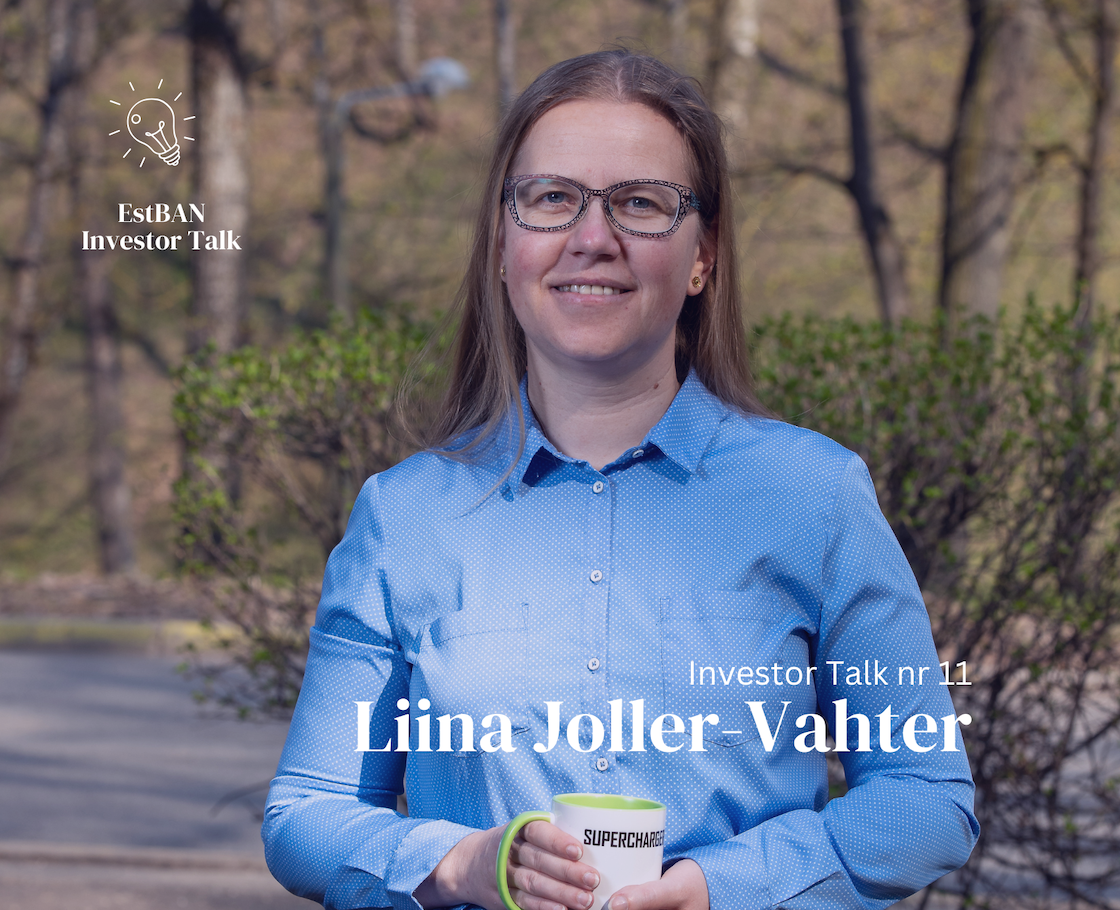
With a background in entrepreneurship, formal education in economics, and a mindset shaped by innovation research, this Investor Talk brings together science, biotech, and angel investing. Liina Joller-Vahter is besides being an angel investor, also a founder of two biotech companies.
Has education shaped the foundation for what you’re doing now?
Yes, my academic path began in textile technology and later continued at the University of Tartu, where I studied Corporate Finance and Investments. That four-year degree provided a strong base that continues to support everything I do today. Understanding cash flows and financial structures is not theoretical knowledge, it is a practical toolkit whatever the sector.
I later completed a Master’s degree in Entrepreneurship and Technology Management (ETJ), a programme that has provided many active members to Estonia’s startup ecosystem, e.g. Gerri Kodres, Riivo Anton, Rain Rannu, and several others. Already back then, the Dutch experts were teaching us due diligence methods and innovation management. That way of thinking has stayed with me ever since.
What did entrepreneurship look like before “startup” became a buzzword?
I was exposed to entrepreneurship early through a family business. One formative experience was working at Ilves-Extra where the Estonian sports brand ISC was built as a spin-out from the very traditional sewing subcontractor. My first responsibility was outfitting the Estonian winter Olympic team for the 2002 Salt Lake City Games. I continued as a purchasing manager for the retail and sports clubs collections. Looking back, it was essentially a startup mindset everywhere: brand creation, product development, financial structuring and growth planning. We just did not use that word at the time.
That period taught me that entrepreneurship is a combination of creativity, operational discipline and financial clarity.
You have a remarkable academic journey behind you. How does that match with entrepreneurship and investing?
After my Master’s studies, I worked quite successfully as a freelance consultant. However, eventually I felt the need for new avenues for personal growth. I pursued a PhD focusing on the diffusion of innovation – how and why new technologies get adopted, products and business models alike and how this process can be accelerated. But deep inside I am not a typical academic person. I am more of an entrepreneur who can switch into a scientific mindset when needed. The ability to operate between these two worlds has become one of my strengths. Today, I continue teaching Innovation Management and Biotechnology Entrepreneurship at Tartu University. For me, teaching is both a way of giving back and a powerful tool for continuous self-development.
How did EstBAN become part of your path?
Although I have been an official EstBAN member for a relatively short time, I have known many members, such as Heidi Kakko and Paavo Siimann, for years through the JCI network (Junior Chamber International Estonia). For me, the greatest value of EstBAN lies in the community – the opportunity to discuss and reflect, but everyone still makes the decisions by themselves. I also value the discussions on what did not go as planned, and what we can learn from these.
What matters when you make an investment decision?
First and foremost – trust in the team. If I don’t trust the founders, I won’t invest, regardless of how appealing the market opportunity seems.
Second, I need to understand how this product or technology will reach the market and scale? I don’t need to grasp every technical detail, but the business logic must be convincing and aligned with my experience.
My angel portfolio is still in development. I have invested in science-driven companies such as Nanordica Medical, Vectiopep and Elnora AI. Bio- and health-tech feel naturally closer to me, partly because of my own entrepreneurial background in the field.
Beyond startups, I also invest in equities and bonds. I believe in data-driven strategies, but personally I do not want to spend excessive time on Excel micromanagement. An experienced investor’s “gut feeling” is the result of years of learning and pattern recognition – not a random instinct.
And besides all of that you’re also a founder.
Yes, I am a co-founder of two biotechnology companies.
Power Algae was established over a decade ago and develops photobioreactors for microalgae cultivation. Building on that experience, we recently launched a spin-out – Supercharger Labs, to provide high-value cosmetic and pharmaceutical components derived from microalgae biomass.
With Supercharger Labs, we are currently raising our first funding round. For me, this is a new perspective – being on the other side of the table as a founder seeking capital. It has added an entirely new dimension to how I think about investing.
What advice would you give to a new angel investor?
Do not blindly follow the advice to “trust your gut”. As I said earlier, a trustworthy gut feeling is not where you start. It is the outcome of years of experience, learning and mistakes. As a new investor, focus on understanding the angel investment process logic, build your network and keep learning. Only then does intuition become a reliable guide.
Photo credits: Andres Tennus, Tartu University