
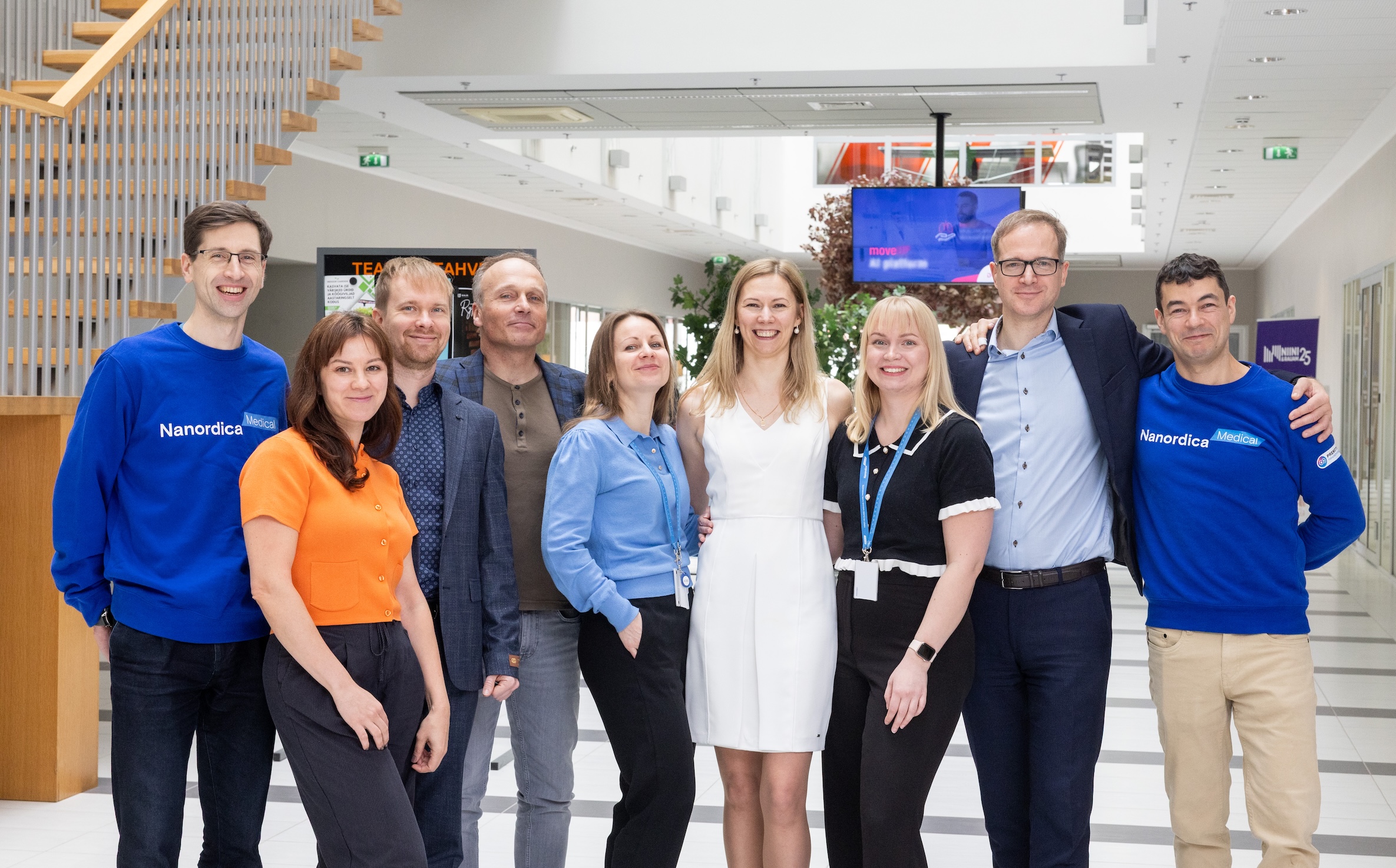
Tallinn, June 10th – Estonian MedTech company Nanordica Medical has raised 1.6M€ to launch its first-in-class wound dressing with Premotiv nanotechnology for fast healing of chronic wounds. The round was led by Estonian fund 2C Ventures[1] with participation from existing investors, Specialist VC, Superangel, Amalfi, Health Founders syndicate led by Erki Mölder and EstBAN syndicate led by Heidi Kakko and Martin Goroško.
Nanordica’s Premotiv® dressing has demonstrated a 43% reduction in wound area size after just one week of treatment compared to 13% with standard silver dressings in a randomized controlled trial on 30 patients with diabetic foot ulcers. The study was recently published in the scientific Journal of Wound Care[2].
Around 100 million people worldwide have chronic wounds that fail to heal. More than half of these wounds become infected, often leading to severe complications such as sepsis, amputation and death. Diabetic foot ulcers (DFUs) are the leading cause of infections and leg amputations among chronic wounds. Every 20 seconds, someone with diabetes loses a leg due to amputation. Often called a “silent killer,” DFUs have five-year mortality rates and treatment costs comparable to cancer[3].
Systemic antibiotics are currently the only treatment recommended for infected wounds by DFU treatment guidelines. However, they often fail to reach wound sites at sufficient concentrations. Their use is also increasingly restricted due to the rise of antimicrobial resistance.
Existing antibacterial dressings are not recommended by wound care guidelines largely because most lack clinical evidence. In addition, to effectively treat infection, many antibacterial dressings typically contain high concentrations of antibacterial agents that can delay healing by damaging healthy skin cells.
Nanordica Medical is addressing this challenge through its patent-protected Premotiv® technology that PREvents infection and proMOTes wound healing at the same time. By overcoming the longstanding trade-off between antimicrobial activity and safety to skin cells, Premotiv® enables faster wound healing and is suitable for both infected wounds and wounds at risk of infection.
In addition to the already published pilot study with 30 patients, Nanordica Medical is currently conducting a multicentered, double-blind, randomized clinical trial in patients with diabetic foot ulcers.
With more than 120 patients already enrolled, it is one of the largest studies of its kind. It is expected to generate strong clinical evidence supporting reimbursement, future treatment guideline recommendations and broader clinical adoption of Nanordica’s technology.
“Current DFU treatment guidelines are not fully aligned with everyday clinical practice, where there is a clear need for effective antibacterial dressings”, said Prof. Dr. José Luis Lázaro Martínez, the Chair of the Diabetic Foot Committee of the European Wound Management Association and the Principal Investigator of Nanordica Medical’s multicentered trial. “Antibacterial dressings supported by robust clinical evidence may influence future guideline recommendations and become category-defining solutions.”
The company’s innovative approach has gained international recognition. In 2026, SmartTRAK, a leading wound care market intelligence platform, named Nanordica Medical among four advanced wound dressing companies to watch, highlighting the company’s unique approach to addressing the “Silver Paradox” in antimicrobial wound care.
“Antimicrobial resistance is one of the defining healthcare challenges of this decade and most wound care products are making it worse. Nanordica has built a clinically proven alternative that doesn’t rely on antibiotics, doesn’t compromise healing, and leaves a significantly smaller environmental footprint. We backed the team because they had both the science and the conviction to see this through”, says Martin Koppel, the Founder Partner of 2C Ventures.
Nanordica Medical launched its first veterinary wound care product, Ravimus Vet[4], in 2023. The product has received positive market acceptance and is currently distributed in six countries.
The human product will be launched following CE marking. To support commercialization, Nanordica Medical has completed key regulatory and operational milestones, including certification of its quality management system in accordance with ISO 13485:2016 requirements. The company has also recently been granted a European patent, strengthening its market defensibility and supporting the expansion of its product portfolio. These activities, including the ongoing multicentre clinical trial, were supported by a €2.4 million European Innovation Council (EIC) Accelerator grant.
“This financing round will enable us to complete a large randomized clinical study, strengthening the economic case for Premotiv® and finalize CE marking for commercial launch in Europe. Our clinical data suggest that Premotiv® helps wounds heal faster by managing infection without compromising natural healing process. Faster healing has the potential to reduce complications, lower treatment costs and improve outcomes for patients with chronic wounds”, said Olesja Bondarenko, CEO and co-founder of Nanordica Medical.
About Nanordica Medical
- Nanordica Medical is an Estonian medtech company founded by scientists and medical doctors, dedicated to transforming laboratory innovations into practical medical solutions. The company is Estonia’s National Institute of Chemical Physics and Biophysics spin-off.
Referrals:
[1] https://www.2cventures.eu/
[2] Roosimaa M, Ilumets H, Kaha T, Kubo AL, Valkna A, Sihtmäe M, Kadaja M, Russell DA, Bondarenko O, Vasiliev G. A wound dressing with copper and silver nanoparticles versus ionic silver hydrofibre dressing for the treatment of diabetic foot ulcers: a randomised clinical trial. J Wou the nd Care. 2026;35(4):300-310. doi: 10.12968/jowc.2025.0002
[3] Armstrong DG, Swerdlow MA, Armstrong AA, Conte MS, Padula WV, Bus SA. Five year mortality and direct costs of care for people with diabetic foot complications are comparable to cancer.
J Foot Ankle Res. 2020;13(1):16. doi: 10.1186/s13047-020-00383-2