

Article written by EstBAN Partner member Hedman Law Firm associates Kaire Sepper and Brigitta Jõgi
If you want to read the same text in Estonian, download the article.
Every entrepreneur knows how important it is to keep company documents and cash flows in order. It is just as important to think through and organize matters that concern your own future and the future of your heirs. Everyone should consider what will happen if something occurs. It is encouraging to see that succession is discussed more and more. These are no longer awkward or taboo conversations but a natural part of the life of a responsible person and entrepreneur. The clearer our decisions and instructions, the easier it is for our loved ones to deal with our estate and for business partners to work with our loved ones.
Composition of the estate
An estate includes both assets and liabilities. The assets include e.g. real estate, vehicles, money in bank accounts, holdings in (investment) companies, rental property, crypto assets, funds held in Wise or Revolut accounts, investments on Lightyear, shares and options. All these items have value and that value may often be greater than the value of a summer house or an old farmhouse left behind in a small Estonian town. You should also decide where to record access codes and passwords for your crypto wallet, Lightyear or other online platforms so that heirs can access them.
An Estonian notary can obtain information about assets registered in Estonian registers and about bank accounts held in Estonia. The notary has no information about assets located abroad. Many people have accounts with banks in Finland, Lithuania and other European countries. Many wealthier families have purchased property in countries such as Spain or Thailand. It is worth considering how succession works in those states and what steps are required there and by whom.
Liabilities are also part of the estate. You should therefore list all loans, leases, guarantees and sureties in order to avoid unpleasant surprises for heirs in the future.
Intestate succession
If a person dies without a will or a succession contract, relatives inherit according to law. Children and the spouse inherit first. If the deceased had no children, the parents inherit. In case there are no parents, the right to inherit passes to siblings. If the deceased had a spouse, the spouse inherits in equal shares with the children but at least 25 percent. If there are no children, the spouse inherits in equal shares with the parents, which is 50 percent.
In intestate succession, the notary determines during the succession proceedings who the heirs are and what share of the estate belongs to each of them. This is often where the problems begin. The next step is to divide the estate, which includes both rights and obligations. Each heir receives a certain share of a mixture that contains both assets and debts. How should this be divided? If no agreement is reached on the division of assets, the court will divide the estate.
In practice, situations also arise where a business owner has divorced but the company has not been divided with the former spouse. If there are children from different relationships, the children and their other parents must start dividing various companies among themselves.
Methods of dividing property
When dividing the estate, it is determined which items or parts thereof, as well as which rights and obligations included in the estate, will be allocated to each co-heir. The estate is divided among the heirs in proportion to their shares of the estate, based on the ordinary value of the items included in the estate at the time of division. This division follows the rules on termination of co-ownership. This means that the heirs divide the assets by agreement. If the value of the assets allocated to one heir exceeds that heir’s share, that heir pays compensation to the others. If no agreement is reached, the estate is sold at an internal auction among the heirs or at a public auction and the proceeds are divided according to the shares.
Thus, by refusing to make decisions about their estate during their lifetime, people often place their heirs in a stressful situation. The wish to avoid uncomfortable decisions may lead to a situation where the court divides the property of the deceased and the bailiff later sells it.
Testate succession
In light of the above, we strongly recommend making a will. A will allows you to specify exactly which assets go to whom. Real estate, cars, company shares, pension funds and money in accounts can all be designated. If the assets do not divide evenly and it is known that nobody wants to keep a particular property, it is possible to order its sale and divide the proceeds equally among the heirs.
Today the number of different family types and the diversity of people’s assets have increased significantly. It is therefore more important than ever to think through the arrangements and future owners of the property. Property is no longer limited to a plot of land, a car and a bank account. It often includes assets acquired worldwide that exist in both physical and virtual form.
Succession of a company
If the estate includes a shareholding in a company, for example a share in a private limited company with a nominal value of 100 euros, the heirs can usually register the share in their names through the Commercial Register. This can be done only after the notary has issued the certificate of succession following the succession proceedings. It is important to distinguish that the company’s own assets and liabilities remain with the company and do not pass into the personal property of the heirs. The inherited asset is the share in the company. The heir steps into the shoes of the deceased as a shareholder.
In practice, it is common that not all heirs wish to participate in business activities. For example, two children inherit their father’s share in a company but one of them does not want to take part in management. In such a case a buyout must be arranged and a fair value determined, which often requires an expert. These steps can be considered and documented in advance.
If there are several heirs, the share is inherited jointly. This means they must exercise voting rights together and decide jointly what to do with the share until they divide it among themselves or someone buys out the others.
It is important to understand that the heir becomes a shareholder with all related rights and obligations. If there were few shareholders, the death of one person may temporarily put company management in a difficult position. Succession proceedings may last at least one month and often longer. During that time the company may face situations where the necessary shareholder or management board member is missing for decision making. In such a case it may be necessary to appoint an administrator for the estate who can exercise the rights and obligations of the shareholder or to appoint a substitute management board member who represents the company. The most critical issues usually involve employees, banks, public authorities and contract partners. The company’s activities should not come to a halt because the company would lose value every day.
Ways to prevent potential disputes
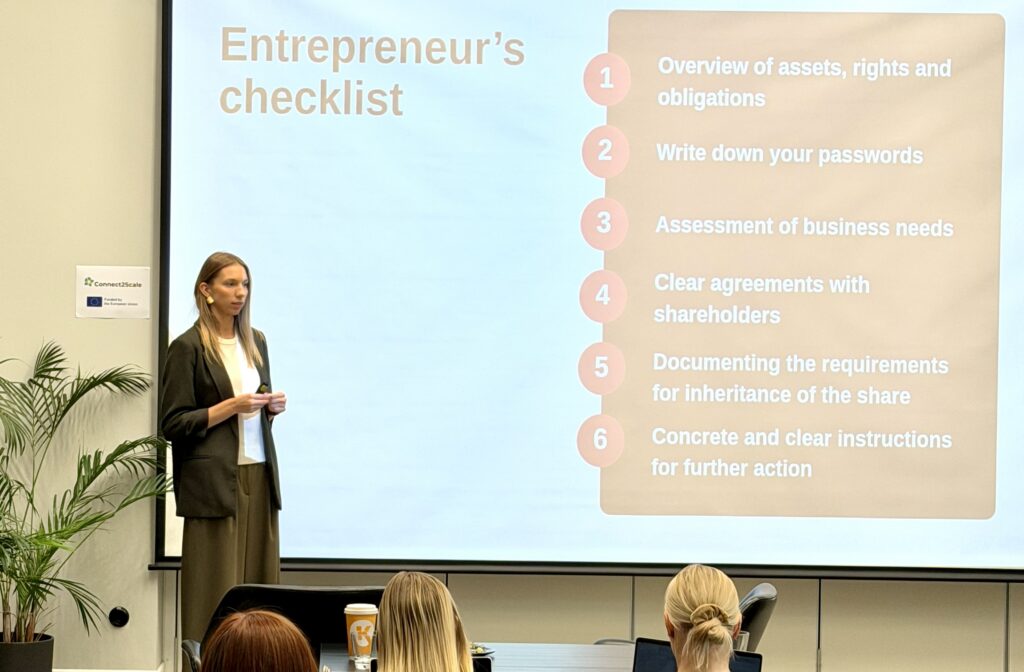
By law, a share is inheritable. Shareholders can however set clear conditions under which the company share will not be inherited. In that case the articles of association must provide that the company pays the heirs fair compensation for the share within a specific time period. This prevents the situation where the company is forced to accept completely unknown persons as shareholders.
An effective way to further regulate relations between shareholders is to conclude a shareholders’ agreement. It helps to establish clearer rules in addition to the articles of association and to set additional rights and obligations related to the share. For example, the parties can agree on the steps a shareholder must take to transfer a share and on the method for calculating the value of the share if needed. Unlike the articles of association, a shareholders’ agreement is confidential and there is no statutory obligation to disclose it.
Although we cannot prescribe whether and how our business partners draft their wills or whom they designate as heirs, we can already now think through whether we would want to run a common business with their potential heirs in the future. If you are founding a company with a friend, it is worth asking yourself whether you would want to continue the same business with that person’s children, partner or other relatives. If the answer tends to be no, this situation can be regulated in advance.
- Hedman Law is EstBAN partner member.
- The article is based on EstBAN x Workland x Hedman Law co-hosted event Morning Mixer: Law Seminar on Inheritance and Succession. The event was supported by Connect2Scale project, financed by EU.